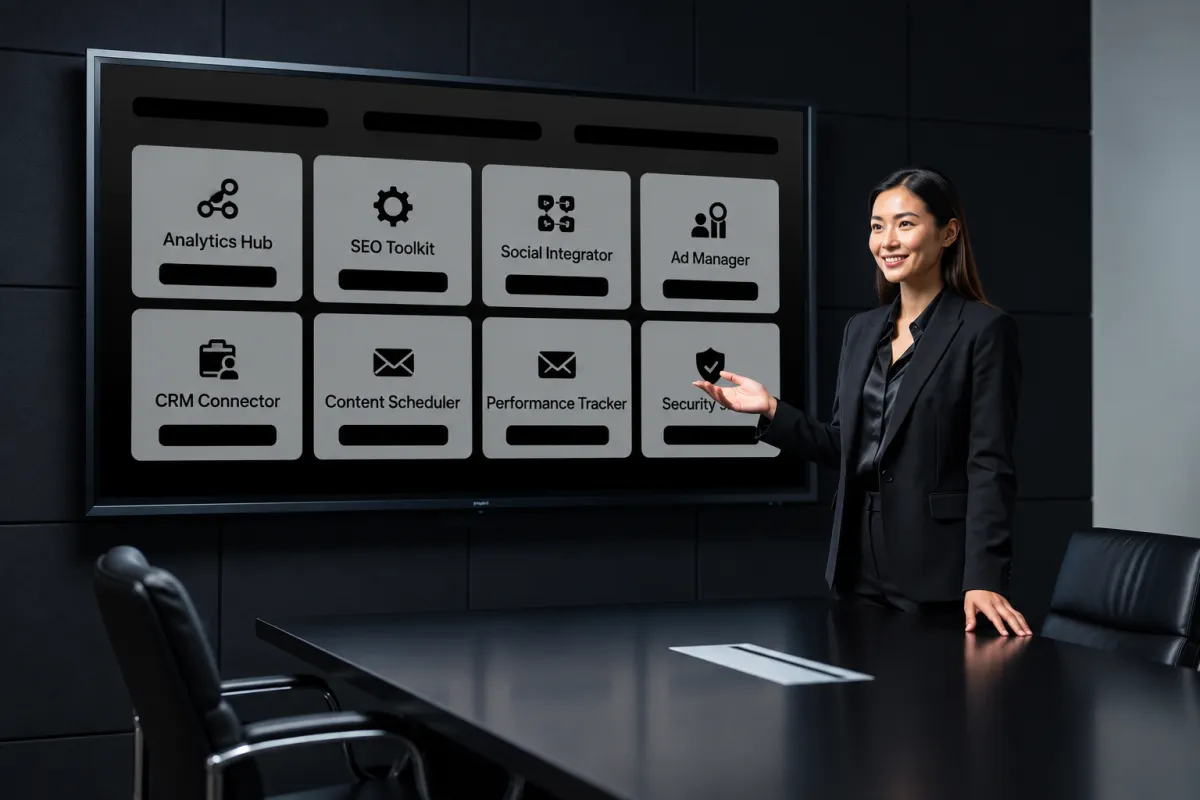
9 Features Every Small Business Digital Marketing Platform Needs
Running a small business is no joke. Between managing customers, handling inventory, and keeping the lights on, finding time to market yourself can feel nearly impossible. That is where having the right digital marketing platform for small businesses comes in to save the day.
But here is the thing: not all platforms are created equal. Some are packed with features you will never use, while others are missing the basics you actually need. As a small business owner, you deserve a tool that works as hard as you do, without requiring a degree in computer science to figure out.
So how do you know what to look for? That is exactly what we are here to help you with. In this post, we are breaking down the nine must-have features that any solid digital marketing platform should offer. Whether you are just starting out or looking to upgrade your current setup, this list will help you make a smarter choice. By the end, you will know exactly what to look for and feel confident picking the right platform for your business.
Why Small Businesses Need a Dedicated Platform Now
If you're running a small business in 2026, the marketing landscape has gotten a whole lot more complicated, and a whole lot more unforgiving for those who aren't keeping up.
Think about how your own customers find businesses today. One person searches Google. Another scrolls TikTok. Someone else asks ChatGPT for a recommendation. A third watches a YouTube review before deciding. Your potential customers are scattered across more channels than ever before, and if you're only showing up in one or two of those places, you're essentially invisible to huge chunks of your audience. According to recent research, over 80% of buyers research online before making a purchase, which means your digital presence isn't a nice-to-have anymore. It's your first impression, your storefront, and your sales pitch all rolled into one.
Here's where it gets tricky for small business owners specifically. As channels multiply, so does the difficulty of measuring what's actually working. Are your Instagram posts driving bookings? Is your email sequence converting? Without a unified dashboard pulling all that data together, you're essentially guessing when it comes to budget decisions. That's money walking out the door.
Google's 2026 spam update has also raised the bar for every business with a website. Low-quality, generic content is being penalized in search rankings, while original, trustworthy, expert-driven content is being rewarded. Simply having a website isn't enough anymore. It needs to actively signal credibility.
And then there's the tool sprawl problem. Managing a separate email platform, scheduling app, CRM, booking system, and funnel builder doesn't just cost money, it costs you time, mental energy, and consistency. Small businesses juggling five or more disconnected tools are at a real structural disadvantage compared to those running everything from one place.
That's exactly why a dedicated digital marketing platform for small businesses isn't a luxury in 2026. It's the smartest operational decision you can make. Consolidating your marketing stack means faster execution, consistent messaging across every channel, and a clearer picture of your ROI. As this breakdown of digital marketing essentials for 2026 makes clear, businesses that show up everywhere their customers are, and do it efficiently, are the ones pulling ahead.
The Hidden Cost of Piecing Marketing Tools Together
Here is something most small business owners do not realize until they are already knee-deep in monthly invoices: the individual cost of each tool looks manageable, but the combined cost is quietly draining your budget every single month.
A typical small business ends up running something like this: an email platform for newsletters and sequences, a social media scheduler to stay consistent across channels, a CRM to track leads and customers, a booking system for appointments, a funnel builder for lead generation pages, and an SMS tool for follow-up texts. That is six separate subscriptions, six separate logins, six separate learning curves, and six separate support teams to contact when something breaks.
The Monthly Bill Adds Up Faster Than You Think
When you start adding up those subscriptions, the numbers get uncomfortable quickly. 41% of small business owners already report rising software costs as a genuine concern for their business. Running six individual tools can easily push your monthly software spend to $300 to $500 before you have spent a single dollar on ads or content creation. That is a recurring cost that compounds every month, and it compounds without giving you the one thing that would actually make each tool more valuable: integration between them.
Disconnected Tools Mean Dropped Leads and Lost Revenue
This is where the real damage happens. When your tools do not talk to each other, data gets stuck in silos. A lead who fills out your landing page form might never make it into your email list. A customer who books an appointment might never get added to your CRM. Every one of those gaps is a dropped follow-up, and every dropped follow-up is a potential sale that quietly disappears. No tool alerts you when the handoff fails because no tool knows the others exist.
Patching those gaps usually means hiring a developer or building fragile third-party workflow connections that break the moment one vendor updates their software. That adds more cost and more complexity to an already strained setup.
The smarter path is consolidation. An all-in-one platform brings email, SMS, funnels, booking, CRM, and scheduling under one roof with native data flow connecting everything automatically. Small businesses are already planning to increase marketing budgets in 2026, which makes fixing the foundation even more urgent. Pouring more money into a fragmented stack does not fix the leaks; it just makes them more expensive. A unified platform like De Cruz Consulting turns those six line items into one, so your data flows where it needs to go and your marketing actually works as a system.
Feature 1: AI Automation That Handles Execution So You Focus on Strategy
Here is something worth sitting with for a moment: according to recent research, 75% of brands have already built generative AI into their marketing strategies as of 2026. That means AI is no longer a fancy upgrade reserved for big-budget companies. It is the new baseline. If you are still manually writing every email, scheduling every social post, and guessing which customers are ready to buy, you are not just working harder than you need to, you are working harder than your competition.
But here is where beginners often get tripped up: not all AI in marketing platforms is created equal. A lot of tools slap a chatbot on top of an existing dashboard and call it "AI-powered." Real AI automation goes much deeper than generating a subject line or drafting a caption. The kind that actually moves the needle for small businesses uses behavioral signals to segment your audience automatically, refines your campaigns in real time based on what is and is not working, and triggers personalized follow-ups based on what a customer actually did, not just who they are. Forbes coverage of small business automation specifically highlights how eliminating repetitive execution tasks- writing follow-up emails, posting updates, managing sequences- is where entrepreneurs reclaim the most time each week.
That time recapture is the real win. Instead of spending your mornings scheduling content and your evenings catching up on follow-ups, you shift into the role of strategic decision-maker. You review what your AI-driven campaigns are already doing, set priorities, and focus on the big-picture moves that grow your business.
The architecture behind the AI matters enormously here. Native AI, meaning AI built directly into the platform rather than added on top, has access to your CRM data, funnel behavior, and customer history all at once. That connectivity is what makes recommendations actually relevant to your business rather than generic. Platforms built with integrated behavioral analytics and journey orchestration at their core outperform surface-level AI tools precisely because the intelligence runs through the whole system, not just one corner of it.
De Cruz Consulting takes this approach seriously. Its AI automation is embedded natively across the platform, which means it can connect email behavior, funnel performance, booking activity, and customer data simultaneously to drive smarter, more personalized campaigns. For entrepreneurs running lean, that means sophisticated marketing execution without hiring a specialist to manage it.
Feature 2: Multi-Channel Presence Without Managing Five Dashboards
Here is the reality of how people discover businesses in 2026: your potential customers are not sitting on one platform waiting for you. They are bouncing between Instagram, YouTube, TikTok, Google, and even AI search tools like ChatGPT before they ever make a buying decision. If your business is only showing up on one or two of those channels, you are not losing because your content is bad. You are losing because you are structurally invisible to the majority of your audience, no matter how good your posts are.
This is where a strong digital marketing platform earns its keep in a very practical way.
One Dashboard, Every Channel
The simplest version of this problem is time. Logging into Facebook, then Instagram, then LinkedIn, then Google Business, then your email tool, one at a time, every single day, is not a marketing strategy. It is a full-time job that pulls you away from actually running your business. A proper platform lets you schedule and publish across all your active social media channels from a single interface, so you write once and distribute everywhere. According to 32 Best Digital Marketing Software Tools in 2026, the industry has decisively shifted from manual setup to intelligent execution, meaning this kind of consolidated scheduling is now a baseline expectation, not a luxury feature.
The Channel Most Small Businesses Are Ignoring
While everyone focuses on social media, SMS marketing quietly sits in the corner with some of the highest engagement rates of any channel available to small businesses. SMS open rates regularly exceed 90%, compared to roughly 20% for email. Most entry-level marketing tools skip SMS entirely, which means businesses using a platform that includes it natively have a genuine edge. When your email automation, SMS campaigns, and social media scheduling all pull from the same contact database, your messaging stays consistent. No customer gets the same promotion twice from two different channels. No one receives a welcome email and a re-engagement text on the same afternoon.
The goal here is not to be everywhere manually. It is to be everywhere automatically, with your platform handling distribution while you stay focused on your offer and your customers.
Feature 3: First-Party Data Tools Built In (CRM, Email Lists, SMS Opt-Ins)
Here is something that most small business owners do not think about until it is too late: the marketing data you have been renting from ad platforms and third-party tracking tools is quietly disappearing. Third-party cookies are on their way out, and with them goes the ability to retarget strangers across the web based on their browsing behavior. What replaces that? Your own customer data, collected directly, with permission. That is first-party data, and right now it is the most valuable marketing asset your business can own.
Your CRM Is the Foundation of Everything
A built-in CRM changes how your entire marketing operation works. Instead of customer information living in a spreadsheet, a separate email tool, and a payment processor that never talk to each other, everything gets captured in one place. The first time someone fills out a form on your website, that contact is created automatically. When they book an appointment, make a purchase, or click through an email, those interactions stack up over time and paint a clear picture of who your best customers actually are. That kind of compounding intelligence is what lets you send the right message to the right person instead of blasting everyone with the same generic offer.
Email Lists You Actually Own
Every visitor who lands on your website and leaves without opting in is a missed opportunity. Integrated lead capture forms and landing pages turn that traffic into subscribers you can reach repeatedly, at no additional cost per contact. Compare that to paid ads, where you pay every single time you want to get in front of someone. An owned email list grows in value the longer you nurture it.
SMS Opt-Ins at the Right Moment
SMS is uniquely powerful because the opt-in often happens at peak engagement. When someone books an appointment or completes a checkout, they are already bought in. Capturing their SMS consent right there means your follow-up sequences reach people who are genuinely interested, not cold prospects. That timing advantage translates directly into higher response rates.
Businesses that build this first-party data infrastructure today are also protecting themselves from whatever privacy regulations come next. Consent-based data you collect directly carries far less compliance risk than third-party tracking, and it will keep working regardless of how platform policies shift. De Cruz Consulting bakes all of these tools, CRM, email list building, and SMS opt-in collection, directly into the platform so you can start building your owned audience from day one without stitching together separate tools.
Feature 4: Hyper-Personalization That Converts at Every Stage
Let's be honest: getting a generic email blast from a business feels pretty tone-deaf in 2026. Customers notice when you're speaking to everyone the same way, and more importantly, they respond to it by clicking away.
The numbers make this impossible to ignore. According to research from Optimizely, 75% of consumers are more likely to buy from brands that deliver personalized content. And Deloitte Digital found that 48% of marketing personalization leaders actually exceed their revenue goals because of it. That puts personalization squarely in the "must-have" category, not the "nice-to-have" one. If your platform cannot do this, you are leaving real money on the table.
So what does personalization actually look like inside a platform? Think about behavioral triggers. A contact who visits your pricing page is in a very different headspace than someone who downloaded your free guide. A smart platform picks up on that difference automatically and drops each person into a completely different email sequence, without you having to lift a finger. One gets a comparison breakdown and a booking link. The other gets nurture content that builds trust over time. That kind of responsiveness used to require a full-time marketing analyst. Now it is built into the automation rules.
Personalization trends in digital marketing have also made dynamic content a game-changer for funnel builders. A single landing page can now display entirely different headlines, images, and calls to action depending on where the visitor came from, what segment they belong to, or what they have previously interacted with. One page does the work of many, and every visitor feels like it was built just for them.
Here is the bottom line: hyper-personalization has shifted from a competitive edge to a baseline expectation. Businesses that skip it are not just missing out, they are actively sending warm leads straight to competitors who took the time to get personal.
Feature 5: AI Chatbots That Turn Website Visitors Into Paying Customers
Think about the last time a potential customer landed on your website at 10 PM on a Tuesday. If your only option was a contact form and a promise to call back within one business day, there is a very real chance that visitor found a competitor who answered them right away. That gap is exactly what an AI chatbot closes, and it does it without adding a single person to your payroll.
An AI chatbot embedded on your website works around the clock, capturing leads, answering common questions, and booking appointments whether you are in a meeting, asleep, or simply unavailable. According to research on AI chatbot lead generation, 64% of businesses report that AI chatbots help generate more qualified leads, and websites using chatbots see an average 23% increase in conversion rates compared to those without. For a small business where every single lead matters, those numbers are hard to ignore.
The speed advantage is especially important for service-based businesses. When a visitor lands on your site with a specific question, a well-designed chatbot greets them based on the page they are viewing, asks a handful of smart qualifying questions, and guides them straight to a confirmed booking slot, often within minutes. That kind of conversion flow is simply not something a contact form can replicate. Testing of leading website lead generation chatbots in 2026 confirms that today's AI agents handle complex conversations, qualify leads by behavior, and book meetings automatically, all while learning from every interaction.
What makes modern AI chatbots particularly valuable is that they are not just a customer service shortcut. They are a first-party data collection tool. Every conversation captures contact information, intent signals, and conversation history that syncs directly into your CRM, building your owned audience at the same time as it serves the visitor.
De Cruz Consulting's AI chatbot is built with exactly this integration in mind. Every interaction is automatically logged, connected to the booking system, and visible inside the same unified dashboard as your email campaigns, SMS sequences, and customer records. Nothing falls through the cracks, and no follow-up requires manual effort. For small businesses that cannot afford slow response times or missed connections, that kind of closed-loop automation is not a luxury; it is how you compete.
Feature 6: Website and Funnel Building Without the Developer Dependency
Let's talk about something most small business owners get wrong from day one: they build a website and stop there, thinking the digital presence box is now checked.
Here is the reality. A website that sits disconnected from your email list, your booking system, your CRM, and your payment tools is not a marketing asset. It is a digital brochure. People visit, they look around, and they leave, with no automated follow-up, no captured contact, and no next step triggered. Platforms that unify website building with email capture, booking, payment processing, and CRM flip that completely. Every visitor action becomes the start of a conversation, not the end of a visit.
The real magic happens when your funnel builder lives inside the same platform as your email automation. Picture this: someone downloads your free guide. In a fully integrated system, that single action automatically enrolls them in a nurture email sequence, books a discovery call if they choose to, and flags them in your CRM so you know exactly where they are in the buying journey. No manual steps, no copy-pasting contact details between tools, no leads slipping through the cracks.
On the SEO side, Google's ongoing algorithm updates continue to reward websites that demonstrate genuine expertise, load quickly, and deliver a credible user experience. A well-built, properly optimized site is not just a place for people to find your phone number. It becomes an organic traffic asset that works for you around the clock, bringing in leads without paid ads.
The good news for small businesses is that drag-and-drop builders with conversion-optimized templates have completely removed the developer dependency that used to slow everything down. You do not need to hire a designer or wait three weeks for a freelancer to launch a professional, functional site. You can move fast, test pages, and adjust based on what is actually working.
And when your funnel includes integrated payment processing, the checkout experience stays smooth and frictionless for the buyer. Revenue data also stays inside the same system tracking all lead behavior, so your numbers always tell the full story.
De Cruz Consulting brings all of this together in one platform, and you can explore it free for 14 days.
Feature 7: The All-in-One Advantage Over Hiring a Marketing Employee
Let's talk about one of the most common turning points for a small business owner: the moment you start wondering whether it's time to hire someone to handle marketing.
It feels logical. You're busy, marketing is taking up too much of your time, and someone told you that you need a dedicated person on it. But before you post that job listing, let's look at what that decision actually costs in 2026.
A junior marketing hire is running anywhere from $48,000 to $72,000 per year in salary alone in most US markets. Once you add taxes, benefits, and employer overhead, that number climbs to roughly $65,000 to $100,000 annually. And here is the part that often gets overlooked: that hire still needs tools. Every channel they manage, whether email, social, SMS, or funnels, requires a separate subscription. You are looking at an additional $200 to $600 per month in software costs on top of their salary, just to give them the equipment to do the job.
Now compare that to an all-in-one digital marketing platform for small businesses. For a fraction of that annual cost, you get email automation, social scheduling, SMS campaigns, funnel building, chatbot responses, and booking management all running simultaneously inside one subscription. That is not the output of one junior hire. That is the combined capacity of several roles, available from day one, with no onboarding ramp-up period.
There is also a risk factor most owners do not consider until it hits them. When your one marketing hire resigns, and statistically speaking they eventually will, you do not just lose a person. You lose campaign access, platform configurations, audience data, and institutional knowledge that took months to build. A platform does not resign. Everything stays exactly where you left it, and your marketing keeps running.
The AI layer makes this comparison even more stark. Embedded AI inside a good platform handles behavioral analysis, content variation testing, and campaign optimization. Those are tasks that would require a senior strategist if done manually, someone whose salary commands a significant premium over even a junior hire.
The smartest sequencing for most startups and small businesses is straightforward: max out what a platform can automate first. Use the built-in analytics to watch where results plateau or where creative judgment seems to be the missing ingredient. That data tells you exactly when and where a human hire would actually move the needle, rather than guessing upfront and committing to $80,000 a year before you have the volume to justify it.
De Cruz Consulting is built around this exact logic. The platform covers the execution layer completely, so the first marketing investment you make goes toward growth, not payroll.
Feature 8: Built-In SEO Tools and a Booking System That Captures Intent
If you are running a service-based small business and your marketing platform does not include built-in SEO tools, you are quietly paying a tax you might not even know about. Standalone SEO subscriptions can run anywhere from $100 to $140 per month just for basic features like meta tag editing, schema support, and site speed insights. When those tools are built directly into your marketing platform, that cost disappears, and more importantly, your SEO data lives in the same place as your campaigns, your contacts, and your analytics. Organic search is still one of the primary ways local customers discover service businesses, and with paid ad costs continuing to climb, it is not a channel you can afford to ignore or outsource to a third-party subscription.
Here is where the booking system becomes the other half of this equation. When a visitor lands on your website after searching for exactly what you offer, their intent is at its absolute highest point. Every second they spend looking for a way to take action is a second they might click away. A booking widget that lives natively inside your platform converts that high-intent moment directly into an appointment, not a form fill that sits in an inbox, and not a phone number they have to dial.
What happens after that booking is where the real leverage comes in. When your booking system connects natively to your CRM, a new appointment automatically creates or updates a contact record, triggers an SMS reminder 24 hours before the visit, and queues an email follow-up sequence for after the appointment. A review request goes out 48 hours later. This entire sequence runs without you touching anything.
For service businesses specifically, the appointment is the sale. Platforms that bolt on a basic calendar as an afterthought, or leave you to connect a standalone tool through middleware, introduce friction at exactly the wrong moment.
With De Cruz Consulting, the booking system is not an add-on. It connects natively to SMS automation, email sequences, and the CRM, so every confirmed appointment moves through a consistent follow-up cycle without gaps or manual oversight.
Feature 9: A Unified Dashboard That Makes Marketing Measurable
Here is something that catches a lot of small business owners off guard: you can be active on five marketing channels and still have absolutely no idea which one is actually making you money.
In 2026, the average small business is running email campaigns, sending SMS broadcasts, posting on social media, showing up in organic search, and possibly running paid ads on top of all of that. Every single one of those channels produces data. The problem is that data is scattered across separate platforms, each with its own dashboard, its own reporting format, and its own definition of what a "conversion" means. When you are trying to make a real budget decision, like where to spend more and where to cut back, you end up guessing.
That guessing has a real cost.
When your marketing tools are fragmented, your reporting is fragmented too. Instead of spending your limited time acting on insights, you spend it copying numbers from one tab into a spreadsheet, trying to reconcile email open rates against SMS click-throughs against booking confirmations. Hours disappear every week to a task that should not exist. The business does not grow faster because you reconciled a spreadsheet. It grows faster because you made a smarter decision with clear data in front of you.
A unified dashboard changes that entirely. When lead source, funnel performance, email engagement, SMS results, and booking conversions are visible in a single view, you stop guessing and start deciding. You do not need a data analyst to tell you that one campaign is producing paying customers while another is producing clicks that go nowhere. You can see it yourself and act on it the same day.
Attribution clarity is where a unified dashboard pays for itself most visibly. Knowing exactly which channel or campaign produced a paying customer is what separates a marketing budget that compounds from one that quietly drains. Without that clarity, businesses routinely pour money into channels that look active but are not actually converting.
The value also builds over time. As historical data accumulates inside a single platform, you gain the ability to spot seasonal trends, benchmark campaigns against previous periods, and understand customer lifetime value in ways that individual tool reports simply cannot support. A snapshot is useful. A year of unified data is a competitive advantage.
De Cruz Consulting includes a consolidated reporting dashboard inside its all-in-one platform, so everything from funnel performance to booking conversions lives in one place from day one. That is the kind of visibility that turns marketing from a cost center into a measurable growth engine.
How to Choose the Right Digital Marketing Platform for Your Business
With over 5,000 marketing tools on the market right now, choosing the right digital marketing platform for your small business is genuinely overwhelming. Here is a practical framework that cuts through the noise.
Start with a stack audit before you look at anything new. List every tool you are currently paying for and match each one to a core capability: email, CRM, booking, SMS, social scheduling, funnel building, chatbot, SEO, and payments. Most small businesses discover they are paying for three or four tools that collectively cover maybe half of that list, with gaps they did not even know existed. Any platform that covers eight or more of those capabilities natively is worth putting on your shortlist and evaluating seriously.
Prioritize integration depth over integration count. A platform advertising 300 integrations sounds impressive until you realize it needs third-party middleware to connect its own CRM to its own email tool. That is not truly all-in-one; that is a loosely stitched-together suite with a polished marketing page. When modules share native architecture, your contact data syncs instantly, your automation triggers fire correctly, and your attribution reporting actually reflects reality. When they are connected through middleware, you get delays, data gaps, and broken automations at the worst possible moments.
Pay close attention to pricing structure, not just the monthly price. Platforms that charge per contact, per email send, or per seat create unpredictable cost curves the moment your business starts growing. A flat-rate all-in-one model gives you stable, predictable economics whether you have 500 contacts or 5,000.
Use a free trial to evaluate against your actual workflows. A platform confident in what it delivers will offer at least 14 days of full feature access. That is enough time to build a funnel, send a campaign, and test the chatbot before you commit a dollar.
De Cruz Consulting offers exactly that: a 14-day free trial with no credit card required, giving you complete access to every feature so you can make your decision based on real experience, not a sales demo.
The Bottom Line on Digital Marketing Platforms for Small Businesses
Here is the clearest way to think about everything covered in this guide: a digital marketing platform is not a software expense. It is an infrastructure decision, the same way choosing a location or hiring your first employee is an infrastructure decision. The right platform replaces five to six separate tool subscriptions, eliminates the coordination overhead of juggling disconnected systems, and actually compounds in value over time as your contact database grows and your automation library gets smarter.
In 2026, a fragmented marketing stack is not just inefficient. It is a competitive liability. Search is splitting across AI engines, social platforms, and voice assistants. Third-party tracking is disappearing. AI is embedded in your competitors' workflows whether they are a solo founder or a 50-person team. Businesses that cannot consolidate their data and automate across channels are falling behind structurally, not just tactically.
When evaluating any platform, lead with the fundamentals: native AI, built-in first-party data tools, multi-channel automation, and a unified dashboard. Individual features matter far less than whether those four pillars are connected.
If you are still stitching tools together, the next step is simple. Audit what your current stack actually costs, map it against a single all-in-one alternative like De Cruz Consulting, and start a free 14-day trial before your next renewal hits. The goal was never to use more tools. It was always to use fewer, smarter, better-connected ones that keep working while you focus on running your business.
Conclusion
Choosing the right digital marketing platform does not have to be overwhelming. The key is knowing what actually matters: ease of use, the right core features, tools that scale with your growth, and a platform that fits your budget without cutting corners.
Small business owners deserve technology that simplifies their workload, not adds to it. When your platform handles the heavy lifting, you can focus on what you do best, running your business and serving your customers.
Now that you know the nine features to look for, you are ready to make a confident, informed decision. Do not settle for a platform that only checks half the boxes.
Start your free trial, book a demo, or compare your current tool against this list today. The right platform is out there, and your business growth is waiting on the other side of that decision.


